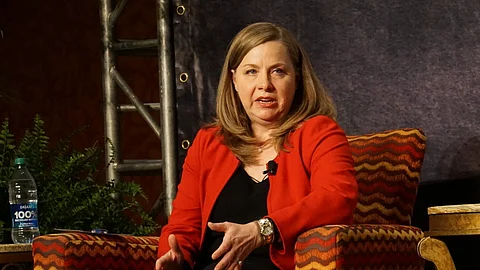
Community banks should be exempt from Current Expected Credit Loss standards, said Federal Reserve Vice Chair for Supervision Michelle Bowman. .Bowman supported the exemption — if not the complete elimination of CECL — May 12 during a Federal Accounting Standards Board meeting. She said the CECL accounting framework includes challenging modeling for lifetime loss forecasting geared more toward larger institutions. That design creates ongoing compliance costs and challenges for smaller banks without corresponding benefits for community bankers, Bowman added. “I have long been opposed to this overly complex and unreasonably burdensome standard,” she said.Community banks would be better served by returning to an incurred loss standard, Bowman said. She sees the previous standard as cost-effective that had worked effectively for decades. CECL went into effect Jan. 1, 2020, for large public companies. CECL came into effect for private companies and smaller banks at the start of 2023. Bowman also recently described her opposition to Regulation O. Speaking May 14 during the Federal Reserve Bank of Kansas City’s 2026 Future of Banking Conference, Bowman said Reg. O, while beneficial to prevent conflicts of interest, also places a disproportionate burden on community bankers. Some potential board members are unwilling to serve because they could not obtain credit cards or lines of credit from the bank, or would be required to bank outside the local community, she added. “The supervisory approach to Regulation O compliance appears to have evolved in a manner that can treat minor technical violations and inadvertent errors with a degree of severity more comparable to substantive violations,” Bowman said. “In some cases, examiners have issued matters requiring attention and other supervisory criticisms, including enforcement actions for menial, unintentional Regulation O issues that do not trigger the rule’s concern about preferential treatment.” Bowman framed her comments as part of the Fed’s larger goal of regulatory tailoring. One example she cited was clarifying Matters Requiring Immediate Attention to focus on shortcomings “that could lead to a material impact on a bank’s financial condition—not procedural or documentation shortcoming that poses no genuine threat to safety and soundness."